
The Bill presented before parliament for the first reading by the State Minister of Internal Affair, David Muhoozi, on Wednesday, April 15, 2026, seeks to regulate how individuals, companies, and organisations receive money or assistance from foreign sources.
Clause 22 imposes a cap on foreign funding of approximately Shs 400 million, or USD 106,000 within any twelve-month period and any funding above this threshold requires the prior written approval of the Minister responsible for internal affairs.
By Alexander Mackey Okori
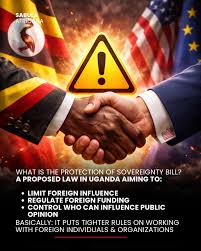
A section of civil society activists and lawmakers from the Karamoja Sub-region have voiced contrasting views over the proposed Protection of Sovereignty Bill, 2026.
The Bill presented before parliament for the first reading by the State Minister of Internal Affair, David Muhoozi, on Wednesday, April 15, 2026, seeks to regulate how individuals, companies, and organisations receive money or assistance from foreign sources.
Clause 22 imposes a cap on foreign funding of approximately Shs 400 million, or USD 106,000 within any twelve-month period and any funding above this threshold requires the prior written approval of the Minister responsible for internal affairs.
The Bill treats violations as serious criminal offences and offenders risk imprisonment of upto 20 years, fine of up to Shs 2 billion for individuals, and up to Shs 4 billion for companies while any money deemed in excess of the limit would be confiscated by the state.
Tomathy Odelok, the Executive Director at Karamoja Women Umbrella Organization (KAWOU), wants the government to drop the Bill, arguing that it could choke civil liberties provided in the Constitution and Uganda’s economic stability.
Referencing Article 38, which provides for citizens’ involvement in governance, Odelok said vague definitions such as “foreigner” and “foreign agent” could criminalize ordinary social and economic interactions.
“Nearly everyone interacts with foreign entities in one way or another, whether through telecommunications, trade, or development partnerships. This law risks labeling all citizens as foreign agents,” Odelok said.
Odelok observed that “Article 1 of the 1995 Uganda’s Constitution insists that sovereignty belongs to the people, but “this twist of sovereignty. The Act removes sovereignty from the hands of the people and shifts it to government. This law will close any economic space for everyone in Uganda…You have a regime that is scared of the economic independence of Uganda”.
Meanwhile, Philip Lokwang Ilukol, the MP for Napore West County in Karenga district, formally endorsed the bill, describing it as a necessary framework to safeguard national stability and independence.
He argued that the Protection of Sovereignty Bill, 2026, is necessary in the context of protecting Uganda’s traditional family values against foreign influence.
When contacted, the Minister of State for Labour, Employment and Industrial Relations Esther Anyakun, who is also the Woman MP for Nakapiripirit district declined to comment on the contentious bill, noting that she is a cabinet minister.
“I’m very sorry to you, but I don’t discuss policy matters on the radio because I’m a cabinet minister”, Anyakun said before hanging up the call.
Meanwhile John Baptist Lokii, the MP for Matheniko County in Moroto district backed the Sovereignty Bill 2026, explaining that it’s the position of the government aimed at safeguarding Uganda against foreign influence.
Lokii said he is a senior member of the ruling National Resistance Movement (NRM) Party and he can’t back-stave his own government by opposing the Bill in motion.
“I can’t discuss about the Sovereignty Bill 2026, because it’s not a private members bill”, said Lokii, calling on those opposed to the bill to write to the office of either the Prime Minister or Attorney General for more explanation on why the bill was introduced.
Efforts to speak to more lawmakers from Karamoja about the controversial bill were futile as a number of them didn’t pick up our repeated phone calls while others were not available by press time.
Among those who didn’t pick our repeated calls are Remigio Achia, (MP Pian Upe County), Margareta Aleper Achilla Kotido Woman MP, Faith Nakutu (Woman MP Napak), Ismail Muhammad Lomwar, (MP Kotido Municipality), Hillary Lokwang, (MP IK County), Peterkhen Lochap (MP Bokora County), and Bantom Ben Koryanga (MP Dodoth West County).
Those who were not available are Peter Abrahams Lokii, MP for Jie County and Jimmy Norman Ochero, Member of Parliament for Labwor County in Abim District.
