
By Alexander Mackey Okori and Cindrella Atenyo
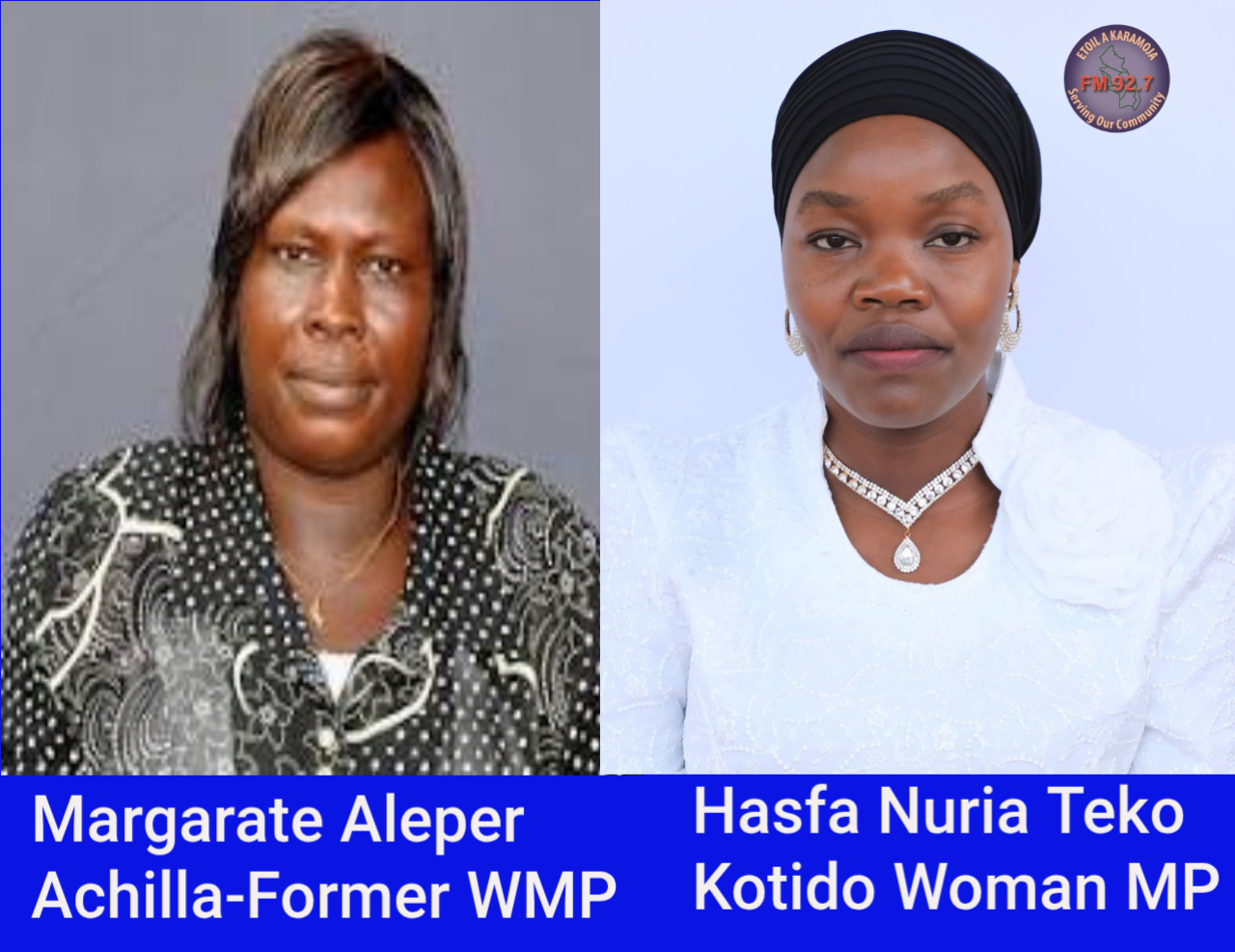
Moroto High Court has upheld the election of Nuria Hafsa Teko as Kotido District Woman Member of Parliament, dismissing an election petition filed by her rival, Aleper Margaret Achilla, who challenged the January 15, 2026 parliamentary election.
According to results published in the Uganda Gazette on March 2, 2026, Teko who contested as an independent candidate after losing the NRM party primaries to Aleper, won the January 15 parliamentary election with 28,820 votes of the total vote cast against Aleper’s 25,962, giving him a majority of 2,858 votes.
However, Aleper in March, 2026 through her lawyers of Ms. Sali Advocates challenged the outcome in Court, citing irregularities and argued that the declaration of the results was illegal and must be set aside.
She said that the Electoral Commission had failed to return and tally the votes for Wum Wum Kanawat 1 polling station, which had a total of 489 voters.
Aleper also accused electoral commission of failing to return the results from Loakobokob polling station in Kagole East in Kacheri town council.
She also added that election results for the Woman Member of Parliament also showed numerous variations compared to that of directely elected Member of Parliament, which to her substantiates Electoral Commission’s failure to conduct a free and fair election.
“There were critical variations in the results of directely elected Member of Parliament against those of the Woman Member of Parliament, a contracts which shows that failure by the electoral commission to conduct a free and fair elections contrary to the article 61 (a) of the 1995 Constitution”, Aleper said in her petition.
According to her, there was a variation of 890 votes of the directly elected Member of Parliament against the Woman Member of Parliament, especially 066 Rengen polling station, which posed a variation of 234 votes.
Aleper further stated that Electoral Commission also allegedly failed to count of the votes of questioned Wum Wum in Kanawat polling station, adding that there were grave inconsistences in the results from Longoman, Lodinyol, Nachuma, Namonicek in Longaroe Sub-county, where the number of unused ballots registered didn’t not correspond with the total number of votes in the declaration forms.
“Contrary to the principles of universal suffrage enshrined in the constitution under articles 1, 2, 8 (a), 20 (2), 38, 59, 62 and 103 of the constitution, the electoral commission failed, and neglected its duty to ensure that all registered voters in the voters register exercise their democratic right to choose a leader of their choice”, Aleper argued through her lawyers of Ms Sali and Advocates.
Shs further alleged that Teko, personally or through her agents, engaged in bribery, treating voters, undue influence, obstruction of voters and election officials, illegal campaigning on polling day and publishing false statements about her character.
However, in a 22 page judgment delivered on Tuesday, November 17, 2026, the High Court Judge Justice Vincent Opyene, declared Teko, duly elected Kotido District Woman Member of Parliament after finding that Aleper, the National Resistance Movement (NRM) candidate, had failed to prove substantial electoral irregularities or illegal practices that could invalidate the election.
He said that although court found that there was non-compliance with electoral procedures involving Lokobokob polling station in Kagole East, the irregularity did not substantially affect the election results.
“The polling station had 487 registered voters, but its results were automatically rejected by the tallying software after the declaration of results form reportedly indicated more votes than registered voters”, the ruling read in parts.
Justice Opyene, explained that under section of the Parliamentary Election Act (PEA), non-compliance is a ground for setting aside an election only where the court is satisfied both that it occurred and that it affected the result in a substantial manner, the two requirements are distinct, and proof of the first does not establish the second.
The judge ruled that the Electoral Commission had failed to provide evidence of a formal decision cancelling the results or showing that the discrepancy had been investigated before the station was excluded from the final tally.
However, the court observed that even if all the 487 registered voters had participated and voted for Aleper, an assumption for which there was no evidence, Teko would still have maintained a lead of 2,371 votes.
The court consequently concluded that the exclusion of the polling station did not affect the outcome of the election in a substantial manner.
On allegations of bribery, the court found insufficient evidence linking people accused of distributing money to voters to Teko or establishing that they acted with her knowledge, consent or approval.
Without evidence of requisite connection, Justice Apyene said their conduct couldn’t be said to have been undertaken with Teko’s consent or approval.
The judge also dismissed allegations of treating voters with alcohol, obstruction, undue influence and illegal campaigning on polling day, citing insufficient independent evidence to substantiate the claims.
Regarding the distribution of salt to residents of Kanamwar, which Aleper presented as an alleged electoral inducement, Teko admitted personally distributing the commodity but maintained that the activity took place on May 2, 2025, during a mobilisation event organised by another politician, Lokii Peter Abrahams, months before nominations.
The court accepted the supporting accounts of witnesses who said the event took place on that date, finding that Aleper had failed to prove that the distribution occurred during the election campaign or was intended to influence voters.
The judge further ruled that allegations involving a video purportedly showing a local leader making statements against Aleper’s character were not proved, partly because its authenticity and the circumstances surrounding its publication had not been established.
In its final determination, the court ruled that Aleper had failed to establish any legal ground under the Parliamentary Elections Act warranting the nullification of Teko’s victory.
The court dismissed the petition and ordered Aleper to pay the costs of the proceedings to both Teko and the Electoral Commission. It also granted Teko a certificate for two legal counsel.
The judgment brings to a close the legal challenge arising from the January 2026 Kotido District Woman MP election, in which 57,263 voters out of 77,000 registered voters participated, representing a turnout of approximately 74.4 per cent.
