
By Alexander Mackey Okori and Bondry Kilenga
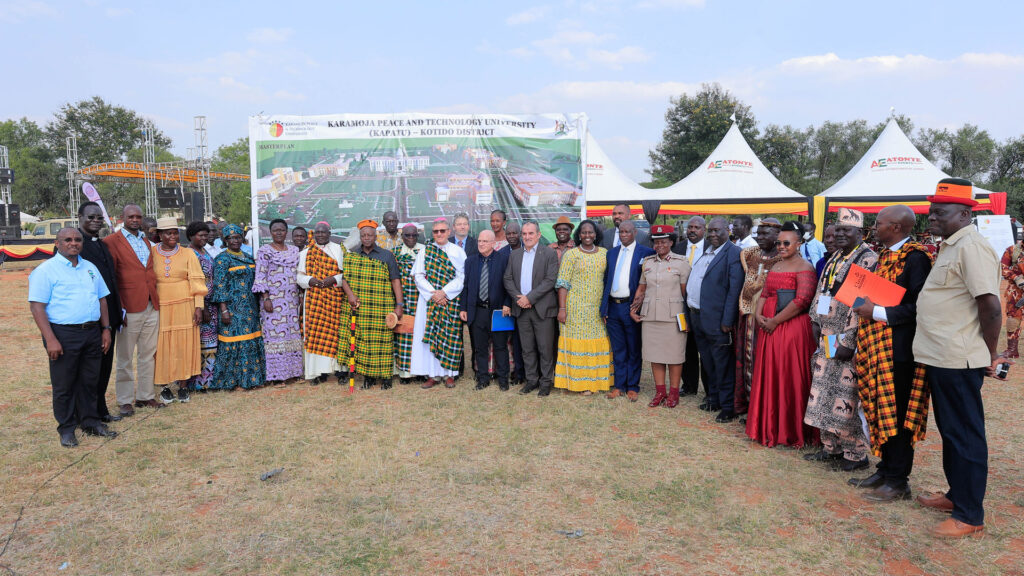
Karamoja Peace and Technology University (KAPATU) and Karamoja Members of Parliament have described the statement by National Council for Higher Education (NCHE), Executive Director, Prof. Mary Okwakol that KAPATU has stalled as “a deliberate move to bias Council members against the University’s application for accreditation”.
On Thursday, April 9, 2026, NCHE’s Executive Director Prof. Mary Okwakol told Parliament’ Sectoral Committee on Education that KAPATU had failed to meet accreditation set guidelines because the proposed governance structures fall short of the legal requirements set by the Council.
Prof. Okwakol also said the University, which is a brain child of Catholic Lawyers Society International and the Catholic Diocese of Kotido and its sister diocese of Moroto is seeking public University accreditation status despite its governance structure not being permitted, and resisted advice to apply for a private license.
However, her submissions have stirred uproar among the University’s leadership and leaders across the Karamoja Sub-region.
Severino Twinobusingye, the president of Catholic Lawyers Society International who also serves as the university’s Third Vice President and Chair of Council, vehemently dismissed the claims as a deliberately calculated pattern of distortion by some actors within NCHE, Ministry of Education and Sports, and Attorney General’s Chambers.
In a press statement released on Monday, April 13, 2026, Twinobusingye, clarified that the University’s leadership had complied with the provisions of the Universities and other Tertiary Institutions Act, including conditions under the Interim Authority issued by NCHE in April 2024.
He added that KAPATU applied for a provisional licence as a private institution in October, 2025, and had already undergone verification by the National Council for Higher Education, which now claims that the university has stalled.
“KAPATU applied for a Provisional Licence on October, 27, 2025, has been better and at team sent by NCHE has verified that all requirements for issuance of the license were in place and findings from the verification report were presented to KAPATU promoters,” the statement reads in part.
Twinobusingye observed that for the Executive Director NICHE to state that KAPATU has failed to comply before the NICHE Council sits to consider the application is “a deliberate effort to bias members of the Council against KAPATU’s application”.
“University, has in place among other things, resourced functional library with both physical and electronic resources, lecture halls, accommodation for staff, a police post and electronic surveillance systems for security of persons and property, fast internet connectivity, the new administration block currently at 42 per cent completion and funded by the partial release of Sh10 billion out of the Shs 30 billion provided by President Museveni” he added.
This, according to him, exceeds the minimum requirements set out under section 101 of the Universities and Other Tertiary Institutions Act, Cap 262 for establishment of a private university.
Charles Mwanguhya Mpagi, the KAPATU Chief Public Relations and Media Officer added a rejoinder to Twinobusingye arguments, clarifying that the committee overseeing the university’s establishment had fulfilled all necessary requirements for approval.
He said that it’s really disturbing that an initiative to deliver the first university in the vast region of Karamoja, in an area that has been largely neglected colonial times and by successive governments, that it gets stuck in a bureaucratic warren.
Mwanguhya Mpagi queried why the National Council of Higher Education keeps on changing every time they meet with the university initiators on the accreditation.
“All the questions that the executive director of the National Council raised in Parliament have been answered variously. What concerns us the promoters is that every time they interface with the National Council, the story changes. They raise new issues, they get answered,” Mwanguhya questioned.
Members of Parliament speak out
Peter Abrahams Lokii, the Jie County Member of Parliament described Prof. Okwakol’s statement as impulsive judgment on the proposed Karamoja Peace and Technology University.
Lokii, who also serves as an ex-officio member of the Karamoja Peace and Technology University (KAPATU) Project University Council, explained that Prof. Okwakol should have allowed the standard procedures followed by other public universities to run their course.
It’s true that KAPATU submitted an application for a provisional license in 2025 as a private university. And it’s also true that the National Council for Higher Education has gone on the ground to visit the university, and in that process, we have made responses to all the requirements as established by law. And the guidance we were given on that day was that the council will be sitting on April 25, 2026, to now give a response to the issues that we have responded to, or the requirements of guidelines that were provided’ Lokii stated.
Lokii noted that it becomes bad faith when the Executive Director of the National Council for Higher Education makes the statement that could have been made.
Janet Okori-Moe, the Woman Member of Parliament for Abim District, questioned NCHE’s reluctance to licence the university, noting that the project enjoys high level political backing.
How can the NICHE Executive Director say that KAPATU does not exist when it has been blessed by the fountain of honour?” asked Okori-Moe.
“Karamoja needs peace, Karamoja needs harmony, Karamoja needs stability and the Karamoja Peace and Technology University is informed by this background, and therefore, we are seeking for inclusion, we are seeking for access, we are seeking for participation, and we are seeking for integration to become part of the greater Uganda,” she explained.
When contacted for a comment, National Council for Higher Education’s Senior Public Relations and Corporate Affairs Officer, Saul Waigolo, declined to come, stating that he was not present during the time Okwakol made submission to Parliament and had not reviewed KAPTU’S response neither did Okwakol answered our repeated phone calls.
Brief facts about KAPATU
Karamoja Peace and Technology University (KAPATU) located in Losilang, Kotido North division, is a pioneering, faith-based public university project conceived in 2014 and launched in November 2025.
Established by the Catholic Church (Moroto and Kotido Dioceses) and the Catholic Lawyers Society International (CLASI), KAPATU Project aims to be a catalyst for changing mindsets and transforming Karamoja and the Ateker region in general, thereby fostering accelerated socio-economic development not only in Karamoja and Uganda, but also in the wider Great Lakes Region and the African continent.
The KAPATU Project’s approach entails integrating formal education, peace education, science and technology, human rights, and psychosocial support to empower the Ateker communities and the entire region affected by cattle rustling and insecurity.
Guided by the philosophy of getting all persons of school-going age (the street and displaced children, child mothers, the Karachunas, former warriors and warriors) in the Greater Ateker Region to go to school and leaving no one behind.
The Presidential Education for Peace Scholarship Program for Karamoja and Ateker (PEPSKA) stands as a cornerstone initiative of the proposed University. It is poised to play a pivotal role in peace-building, thereby enhancing human resource capacity in the region.
The KAPATU Project according to the initiators has the potential to create over 2,000 jobs every year to help the Government of Uganda partly answer the question of unemployment within Karamoja and Ateker Regions.
