
AGENCY
Kenya is navigating a familiar but increasingly delicate role in Nile Basin diplomacy: principle without partisanship.
Nairobi has reaffirmed its long-held position that no riparian state should be left worse off by the use of shared water resources, framing the Nile as a collective asset rather than a zero-sum contest.
Speaking in Nairobi alongside Egypt’s Foreign Minister, Musalia Mudavadi said Kenya remains committed to African-led, dialogue-driven solutions under the Nile Basin Initiative and is willing to act as an impartial facilitator.
By explicitly acknowledging Egypt’s call for dialogue, cooperation, and mutual respect, as articulated at the December 2025 Nile Council of Ministers in Bujumbura, Kenya offered Cairo diplomatic recognition without endorsing its maximalist claims.
Egypt is deepening its engagement with Kenya, pledging about $7 million (Sh903 million) for high-impact development projects and offering targeted capacity-building in diplomacy, security, agriculture, and religious leadership.
Consultations on how to operationalise these commitments are ongoing.
Between the lines, water diplomacy here looks less like an abstract principle and more like calibrated positioning. Kenya is not choosing sides, but it is choosing relevance.
That balancing act is complicated by Nairobi’s parallel ties with Addis Ababa.
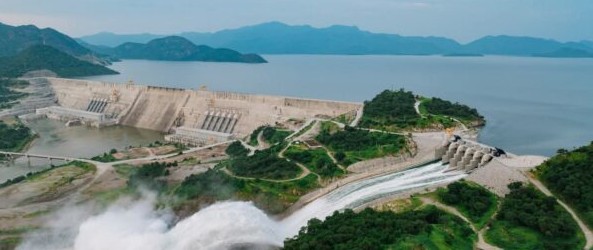
President William Ruto attended the inauguration of Ethiopia’s Grand Ethiopian Renaissance Dam in September 2025, alongside leaders from Djibouti, South Sudan, and Somalia.
The $5 billion (Sh645 billion) project, now fully operational, is Africa’s largest hydroelectric dam and a political symbol of upstream assertiveness.
Egypt, downstream and heavily dependent on Nile flows, continues to warn that unilateral upstream projects threaten its water security and breach international norms.
Cairo still cites colonial-era agreements that allocated the lion’s share of Nile waters to Egypt and Sudan—arrangements upstream states reject as obsolete.
Earlier this month, Egypt’s Foreign Minister Badr Abdelatty held consultations with Mudavadi to coordinate positions ahead of the AU summit in Addis Ababa, describing the search for a “win-win” outcome on the dam.
Kenya’s response has been consistent: utilisation is legitimate, provided no one is left worse off.
External actors are also circling. In January, Donald Trump offered to mediate between Cairo and Addis Ababa, reviving outside interest in a dispute that African institutions have struggled to settle.
Beyond water, Cairo is broadening its relationship. Abdelatty met Kenyan business leaders during his Nairobi visit, and Egypt has proposed a state visit by Abdel Fattah el-Sisi later this year, potentially timed around the Africa–France Summit in Nairobi in 2026.
Do you want to send us a story? SMS or Call +256-787-551-001 or WhatsApp +256-770-450-528 or Submit on on email eetoilnewsdesk@gmail.com
