
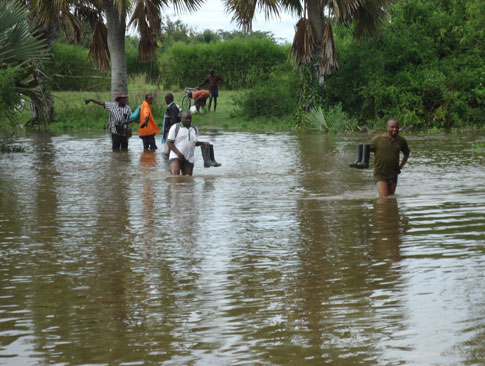
The government has warned of potentially heavy rainfall, floods and landslides during the September–December 2026 rainy season.
The warning comes as hundreds of thousands of people in Karamoja continue to face acute food insecurity.
Office of the Prime Minister (OPM), in a disaster status report presented to Parliament, warns that preliminary climate outlooks point to a high probability of above-normal rainfall episodes in several parts of the country during the September–December season.
Flood-prone lowlands, urban centres with inadequate drainage, river catchments, wetlands and mountainous areas are particularly vulnerable.
The warning comes after a poor March–May rainfall season that caused drought and food security challenges, particularly in Karamoja, Teso and the cattle corridor.
The drought has resulted in crop failure, inadequate water for domestic and livestock use, increased movement of pastoralists in search of water and pasture, and reduced production.
The report noted that a food security and nutrition assessment by the Ministry of Agriculture, Animal Industry and Fisheries and partners found that about 473,000 people, representing 32 percent of the analysed population in Karamoja, were facing acute food insecurity between April and July 2026.
Of these, 41,000 people were in IPC Phase 4 (Emergency), while another 432,000 were in IPC Phase 3 (Crisis).
All nine districts in Karamoja are classified in crisis, with the most severe conditions reported in Kaabong, Kotido, Karenga, Moroto and Nabilatuk.
In some of these districts, up to five percent of the population is in Emergency, while as many as 45 percent face Crisis or worse conditions, according to the report presented to Parliament.
Sam Engola, the Minister of Relief, Disaster and Refugees, says the government expects the situation to improve seasonally between August 2026 and February 2027, with the number of people facing Crisis or worse projected to fall to about 352,000, or 24 percent of the analysed population.
However, the report warns that food insecurity will remain persistent, particularly in Kaabong, Kotido, Karenga and Moroto, where between 25 and 35 percent of households are still expected to experience Crisis-level outcomes.
The disaster report says Uganda’s June–August rainfall season has already triggered several disasters, including hail and windstorms, lightning, floods and flash floods.
Hail and windstorms have been reported in Kikuube, Bunyangabu, Pader, Kamuli, Isingiro, Hoima City, Tororo, Namisindwa and Bukedea, while lightning incidents were recorded in Abim.
Flooding and flash floods have also affected Alebtong, Tororo, Namisindwa, Kampala Capital City and other areas. The report highlights the continuing vulnerability of the Mount Elgon area.
In Namisindwa, landslides and widening ground cracks have increased risks to homes, farmland, roads and other infrastructure, with more than 500 villages reported to be at risk.
Earlier flooding in Tororo also affected more than 50 families after River Malaba burst its banks, damaging houses, crops and livestock, while heavy rainfall in Kaliro damaged roads and bridges and disrupted transport, movement and trade.
Country’s readiness
The OPM says it has established an inter-ministerial technical committee to prepare an El Niño contingency plan, which will be submitted to Cabinet for approval.
The plan will provide for interventions before, during and after the expected rains and will cover agriculture and food security, works and transport, health, education, energy, trade, water and environment, housing and urban development, among other sectors.
The government has also started disseminating early-warning information through radio programmes, community meetings, barazas and school assemblies.
District Disaster Management Committees have been directed to update contingency plans, reactivate their committees, conduct risk assessments and share El Niño alerts with communities at risk.
District authorities have further been warned to enforce physical planning and environmental laws to stop settlement on steep mountain slopes, near riverbanks and lake shores.
The report calls for a range of preventive measures ahead of the expected rains in the ministries and local governments, including assessment of roads and infrastructure, activation of rapid response teams and water monitoring systems.
In response to the drought in Karamoja, the government has begun distributing relief food to 313,987 affected households across 480 parishes in all nine districts.
Each household is expected to receive 20 kilogrammes of posho and 10 kilogrammes of beans for the initial two months of July and August 2026.
The report says the combination of drought, food insecurity and the prospect of heavy rains presents a complex disaster-management challenge for government, requiring early preparation to protect lives, livelihoods and infrastructure.
The OPM has also called for measures to restore degraded mountain ecosystems and address the immediate needs of disaster-affected communities, including health, hygiene, shelter, sanitation, livelihoods, and non-food items.
SOURCE URN
